
Students thrive when schools prioritize support
MEDICINAL MEDIA + SOLUTIONS JOURNALISM NETWORK HEAL FELLOWSHIP Illustrations by Jon McCormack
by Keelin Everly-Lang
When school counselor Melissa Juvik started her job at Custer Elementary School about eight years ago, she summed up the environment in one word: chaos.
“There were just constant disruptions…kids were hyper, dysregulated…we used to have habitual room destroyers…everything would come off the shelf…everything would be thrown, chairs chucked, and we'd have to reverse evacuate the majority of the class for the kid having the tantrum,” Juvik described. “That was cultural. It happened daily in multiple rooms.”
Today, that just doesn’t happen.
The school’s cultural shift has raised them from the academic bottom to twice winning the Best of the South Sound award for the Best Public School. These changes come from implementing Integrated Multi-Tiered Systems of Support (I-MTSS) to “build a strong school culture based on community and belonging,” as principal Kathy Weymiller shared in an announcement about the 2026 award.
This culture looks like 97% of students reporting in a 2023 survey that they have friends, have adults that care about them at school, and are treated as well as other students. Additionally, 96% of surveyed students felt safe at school and 95% said their teachers make them feel included in class activities.
What does all of this data have to do with changes in academic performance or behavior? Quite a lot, it turns out.
What is I-MTSS?
I-MTSS is a framework that brings together the many different needs a student has at school. Tier 1 establishes universal supports designed to meet the needs of the majority of students. Additional targeted intervention strategies, Tiers 2 and 3, are then implemented for those whose needs are not met by that first tier of supports.
This strategy and other tiered frameworks have become very popular throughout the U.S., with some form being used in every state, but the research and reporting on how well it is working is lagging behind.
In a report from the I-MTSS Research Network from 2024, they found that “widespread adoption and implementation of I-MTSS may have outpaced emerging, yet promising, I-MTSS research…more information is needed to document efficacy of I-MTSS in both controlled and typical conditions.”
This idea of balancing universal and targeted support is not new and was applied in Public Health and Community Mental Health as early as the 60s according to the I-MTSS Research Network. Throughout the years it was applied to special education for students with disabilities, and through various lenses of behavior and academics.
The newest version of the approach seeks to bring together tiered support systems that previously focused just on academics or just on behavior. Some of the major frameworks that combined to form I-MTSS include Positive Behavioral Interventions and Supports (PBIS), Response to Intervention (RtI).
In Seattle Public Schools, local expert Dr. David Lewis contributed to this growing body of research through a seven-year study by the University of Washington as he implemented I-MTSS throughout the school district. He’s now helping other schools using the findings of this research, including Custer Elementary.
When I visited Custer recently, I saw the power of I-MTSS in action early in my day when I met two students who were selected to read the morning announcements.

When asked about their favorite part of school it struck me that the five-year-old boy didn’t choose the typical recess or lunch: He shared that at Custer, “We get to be safe and learn.”
When asked about their favorite part of school it struck me that the five-year-old boy didn’t choose the typical recess or lunch: He shared that at Custer, “We get to be safe and learn.” Later I was informed this little boy had already experienced homelessness multiple times and several interventions from Child Protective Services (CPS). As I saw him throughout the day, he seemed like any other happy kid, proud to be chosen to read the lunch announcement. And later, he quietly completed an Earth Day activity along with his classmates.
The calm and supportive environment I saw in that classroom is just one of the visible results of integrating all three tiers of I-MTSS, staff told me. While Tier 1 focuses on the overall climate and culture of a school, Tier 2 provides targeted small-group support. Tier 3 delivers intensive, individualized interventions for students with the greatest needs.
Consistency is critical
At Custer, Tier 1 changes have included creating consistent and clear expectations schoolwide, rolling out a new school creed, and adding new practices for recognition and celebration.
Before the MTSS implementation, things were much different – not because teachers lacked skills or training on how to support the children in their classrooms. Instead, the problem was, “everyone kind of was doing their own thing,” Juvik told Medicinal Media. “They were doing what they knew, and it wasn’t bad…but when everyone’s doing their own thing, for academics, for behavior, for just everything school wide, how are kids supposed to meet all those different expectations in every different space they go to?”
Lewis explained that when he begins working with a school, the staff often believe they have consistent expectations in place, but this is typically not the case. He’ll often have them define what the word “respect” means and how it looks in the classroom, and he says they are consistently shocked by how different all the responses are.
Now, whether Custer Elementary students are in a hallway, classroom, lunchroom, or even the restroom, there are posters in a consistent format with clear expectations presented in both words and pictures.
Other changes are visible on a large wall near the front of the school where students are celebrated for embodying the school’s new creed of Respect, Ownership, Achievement, Resilience, and Safety (ROARS). This creed is posted everywhere, integrated into school activities, and students who demonstrate them are celebrated. One reward is having their photo featured in a giant display in the main hallway of the school, highlighting how well they displayed an element of the school’s creed. Teachers also now have a consistent “signal for learning” to help their students transition into class and focus in the classroom.
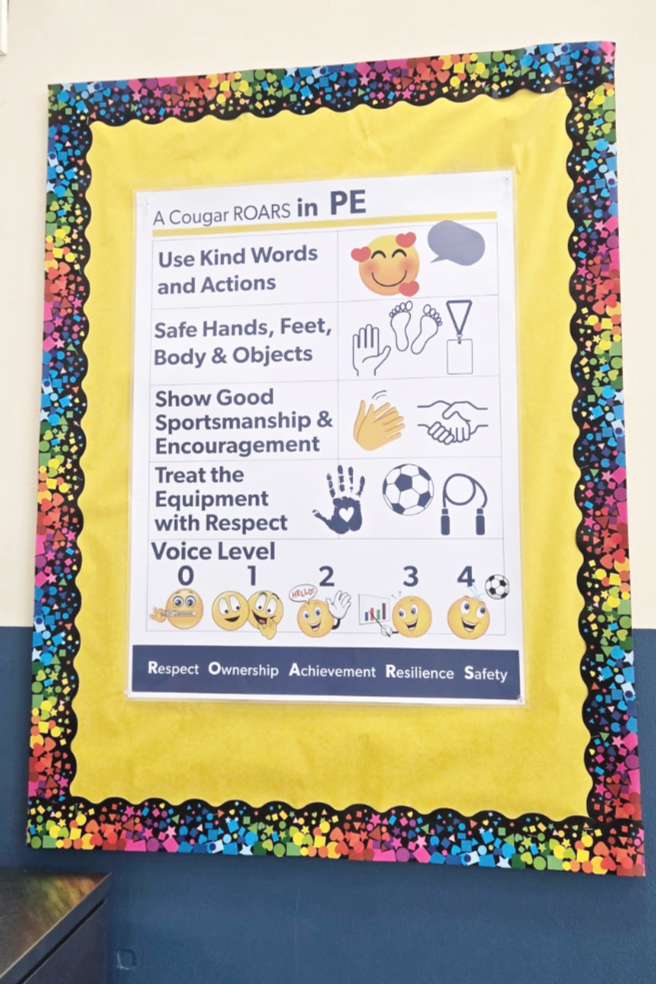
A version of this poster is in every room of Custer Elementary.
They all start with the expectation to “use kind words and actions” and to have “safe hands, feet, body and objects” then have other expectations tailored to the situation, like inside a classroom or at lunch.
Changing a school culture
These changes did not come easily or happen right away.
Weymiller and Juvik started working at the school around the same time, and although Juvik was on board with the I-MTSS changes pretty quickly, Weymiller was initially quite skeptical. In her 40 years as a principal, she has seen countless different educational strategies, including promises that a new technology will be the silver bullet that changes everything.
While I-MTSS is not a silver bullet, Weymiller was amazed by the difference it made for the school, even though some staff members are still not on board.
Some of the most comprehensive data about I-MTSS comes from education technology company Panorama, that provides software to help track the data that helps identify student needs within the tiered intervention system. In a 2023 survey, out of 600 responses, 43% shared that faculty and staff buy-in is actually the biggest challenge of implementing MTSS. The biggest challenge was related, with 48% choosing “implementing with fidelity” as the hardest part.
The guide Implementing MTSS at a Sustainable Pace by Branching Minds also highlights the importance of stakeholder engagement and recommends “involving educators, parents, and students in the planning and implementation process” in order to “ensure buy-in and relevance.”
In addition to focusing on buy-in from faculty and other community leaders, two other consistent themes came up across implementation research and Lewis’s research. The first is to tailor approaches to the population served by the individual school and the second is to really focus on implementing consistency in the Tier 1 – universal supports – before rushing to focus on the specialized interventions.
These themes are echoed in the Branching Minds implementation guide, which shares that “the MTSS model should be adapted to address the unique needs of each district. This might mean focusing more on certain tiers of support or integrating specific cultural or community aspects into the model. Custer, for example, has a student population where 50% have special needs, many come from military families that move frequently, and students come from diverse cultural and socioeconomic backgrounds. To meet the I-MTSS goal of having Tier 1 universal support meet the needs of 80% of the students, Custer’s basic school systems need to reflect those demographics.
Custer’s student population has different needs than another school that Lewis worked with: a tight-knit, affluent community with high tuition who were surprised and devastated by a series of student deaths by suicide.
“Those kids are dealing with such high expectations that they believe they can't meet,” Lewis said. That level of perfectionism, “that gap between pretty darn good and perfect, that really is not achievable and creates an elevated stress response that impacts that kid's mental health.”
Regardless of the school’s demographics, increasing a sense of belonging and safety through I-MTSS can have an impact at any school, Lewis’ research has found. In Washington State, a guidebook was rolled out in 2025 to detail expectations, goals, and practical support for implementing MTSS at scale. It includes a wide variety of resources to support districts anywhere in the country with implementation.
For those wondering just how long it takes to implement the program, this guidebook lays out a timeline, starting with spending the first year to two years establishing foundational training, developing MTSS leadership goals, and aligning policies. This can be a good time to identify ways to make space in overall school systems to implement new supports, like adding dedicated time into school schedules.
In Nevada for example, five Carson City schools received awards earlier this year for their success with implementing MTSS and the academic and behavior gains they saw. One of their many action steps was to add intervention blocks that were built into their school day to “address specific gaps or issues in learning.” One of these groups was designed to “help second-graders with anger management and [who] are struggling at recess,” MTSS Coordinator Stephanie Keating said in news coverage of the awards.
For years three and four of implementation, the goal in Washington is to scale across all schools, monitor data, and refine interventions; by year five, MTSS will be embedded in the district’s culture, and the district will continue to evaluate effectiveness and adjust strategies based on outcomes.
In the Branching Minds guide, they suggest beginning this process with a universal foundation of basic MTSS elements, then continuing to add additional specialized interventions and supports once that first tier has been established. Lewis also emphasizes Tier 1 as an effective place to start, and his data backs that up. With the data he has collected so far, he can now guarantee that if a school's overall climate and culture improve, behavioral issues will go down and test scores will go up.
“The schools that reached 90-something percent positive on those surveys, their disciplinary action went down significantly, and their achievement went up,” Lewis explained. “And I'd say any and everywhere I've been, that has happened. When 97% of kids say ‘I enjoy school. I'm happy at school. I feel like people care about me,’ you walk into that school, and it's a pretty calm, welcoming atmosphere.”
Put simply, when kids feel safe, cared about, and valued, they are able to take on challenges that can, in turn, build their confidence and self esteem.
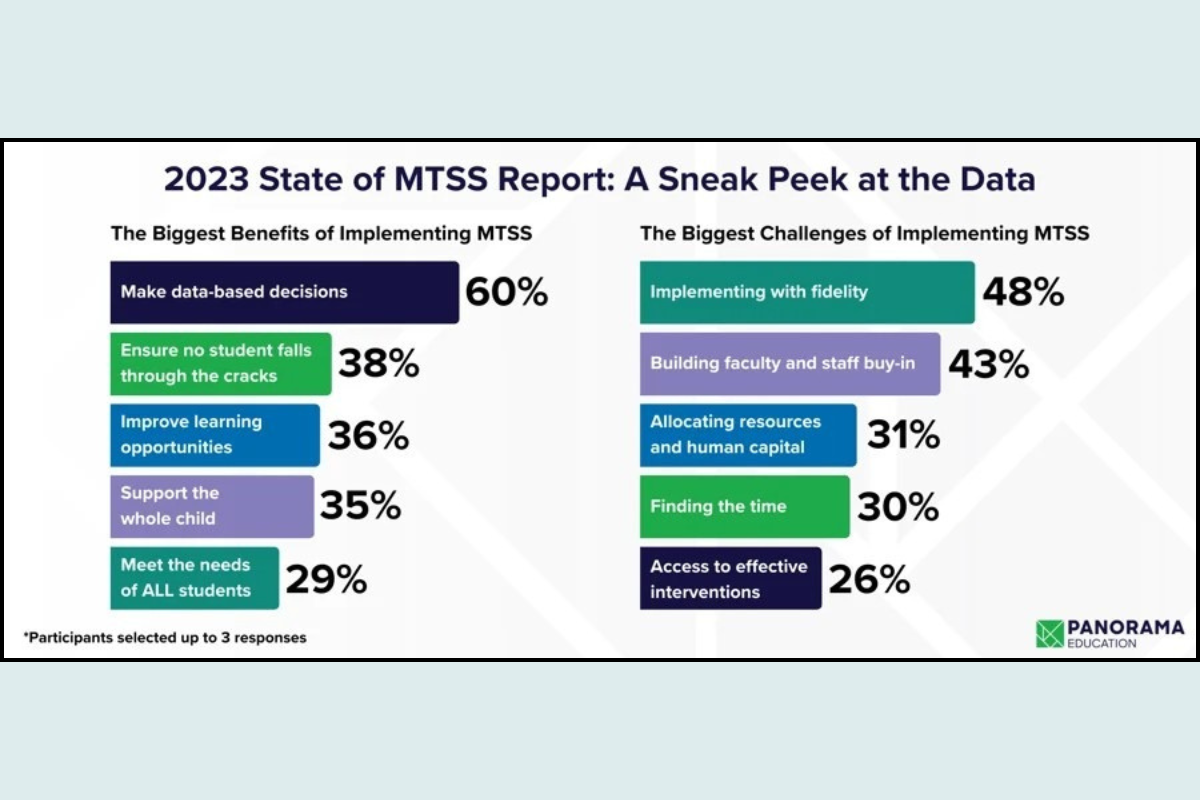
Survey data from Panorama Education details experiences of some educators in implementing MTSS
Belonging and the brain
Considering the importance of belonging through the lens of neuroscience, the importance of this metric also becomes clear.
In Psychology Today, Terrell L. Strayhorn Ph.D. explains: “Feeling like one belongs through strong, supportive social connections activates reward-related regions of the brain (e.g., ventromedial prefrontal cortex) and triggers the release of ‘feel good’ neuropeptides (or transmitters) such as serotonin, dopamine, and oxytocin.”
Each of these neuropeptides have their own impacts on the system. Oxytocin, for example, “lowers anxiety, improves mood, sharpens decision-making, and boosts memory and learning.”
On the other hand, a lack of a sense of safety and belonging puts the brain into a state of high stress that makes it extremely challenging to take in new information. In a ten-point scale of stress where ten is the highest, the optimal level for learning is four or less. At this level of stress, the frontal lobe is engaged and new information is able to be processed and retained.
But, Lewis said, “if students are in an environment that has them at a nine or a 10, that brain is looking for safety…and information is not going to come in very well in academics, in achievement. No matter what math curriculum you're using, it doesn't matter if that part's not set up.”
This state of acute stress means the body’s sympathetic branch of the autonomic nervous system is activated, often referred to as “fight or flight.”
In this state, all of the body’s resources are focused on survival, at the expense of processes that are needed for long-term wellbeing, like learning or even proper digestion. Staying in this state for long periods of time can cause damage to the body’s ability to function properly, which can lead to long-term health risks. In a lower state of stress, the body switches to the parasympathetic nervous system, also known as a state of “rest and digest.”
Creating optimal environments for learning doesn’t mean students should be insulated from feeling any stress ever, which can also have harmful impacts. Instead, Lewis explained the goal is to build resilience by helping students take risks and manage challenging experiences in a supportive environment where they feel cared about. Going back to the nervous system, this means building capacity to return to a regulated state after becoming dysregulated.

“If students are in an environment that has them at a nine or a 10 [stress level], that brain is looking for safety…and information is not going to come in very well in academics, in achievement…no matter what math curriculum you're using, it doesn't matter if that part's not set up.” — Dr. David Lewis
Basic needs first
At Custer Elementary, the school principal and school counselor said a common phrase at the school is “Maslow before Bloom.” This is a reminder to make sure that student’s basic needs are met (referring to Abraham Maslow’s Hierarchy of Needs) before they can try to meet academic goals (referring to Benjamin Bloom’s Taxonomy of Educational Objectives).
To ensure these basic needs are met, and to strategize on interventions for Tier 2 and Tier 3 needs, MTSS sets up a framework of staff communication. This allows multiple staff that work with a student to develop a plan and track interventions together to see what is working. This way, they can coordinate their approach, and if something isn’t working, they can talk through ideas on what to try next.
One Custer student I spoke with during breakfast was a tiny six-year-old with a big personality. He had a unique style and was confident, talkative, and full of opinions about school, adults, and his teachers. Jake* is also the school’s resident expert on the axolotl salamander that covered his pink and purple backpack. He chatted away while holding his forgotten breakfast of french toast and happily went off to class when Juvik let him know it was time to get going.
Jake had not always started his mornings this way. In the past, I was told, it was more common to see him screaming cuss words at the top of his lungs, raising his tiny middle fingers at the world, and running out of the school at any opportunity. A school resource teacher said, at one point, he punched her in the nose. Jake had such challenging behavior problems that he was almost never in class. He missed so much that he had to repeat kindergarten.
Jake is exactly the kind of kid that Tier 3 supports are built for. While he still has hard days, he’s doing much better.
School life versus home life
While I-MTSS can be very successful in meeting every category of need, educators have little control over what happens when students exit the school at the end of the day.
One limitation of I-MTSS that teachers and other resource staff at Custer shared with me is the contrast between the school environment and their home life. They shared that it can be very frustrating to be making great progress with a student, only to see worse behavior after a week of school break (much less summer vacation).
Now that they’ve gotten the school environment to a calmer, more functional state, Custer staff are looking for ways to work on this challenge. One strategy they’ve tried is holding parent education classes to work on family skills. As with changes in staff instruction, the focus remains on creating consistency and clear expectations in the shared village of adults who nurture a young person in the community, not on criticism.
At the end of my day at Custer, I saw Jake one more time. I had just left his classroom full of loud, joyful kids engaging in a dozen different high-energy activities all around the room. It was enough to overstimulate anyone, much less a six-year-old who already had trouble regulating.
Sure enough, a few minutes later, he appeared in the hallway to talk to his resource teacher. Nine years ago, a similar situation with another student at the school could have escalated into thrown fists, a storm of tears, an escape attempt, or numerous other issues.
Now, Jake used the words he had learned in his Tier 3 interventions, and asked for a break.
*Names and certain details changed to protect student privacy
Keelin Everly-Lang (she/her) is a solutions-focused journalist, speaker, trainer and content creator based in the Seattle/Tacoma area of Washington State. She is especially passionate about solutions that are centered in environmental and food justice that increase the wellbeing of both people and the living planet. Her current work includes multiple roles. She is a fellow with the Solutions Journalism Network’s Youth Building and Belonging cohort, the Editorial Engagement Manager for the Weekly Volcano newspaper, the Community Engagement Manager for vintage campground and community event space Camp MoxyJo’s, and is also the co-founder of the recently launched independent journalism initiative UNTOLD.
Jon McCormack is a Dublin-based illustrator with experience in editorial, advertising, and publishing. Storytelling and atmosphere are pivotal to his work, with inspiration derived from cinema, queer culture, sequential art, and absurd humor.

Illustration by Jon McCormack