
Glimmers Inspire a shift toward self-compassion
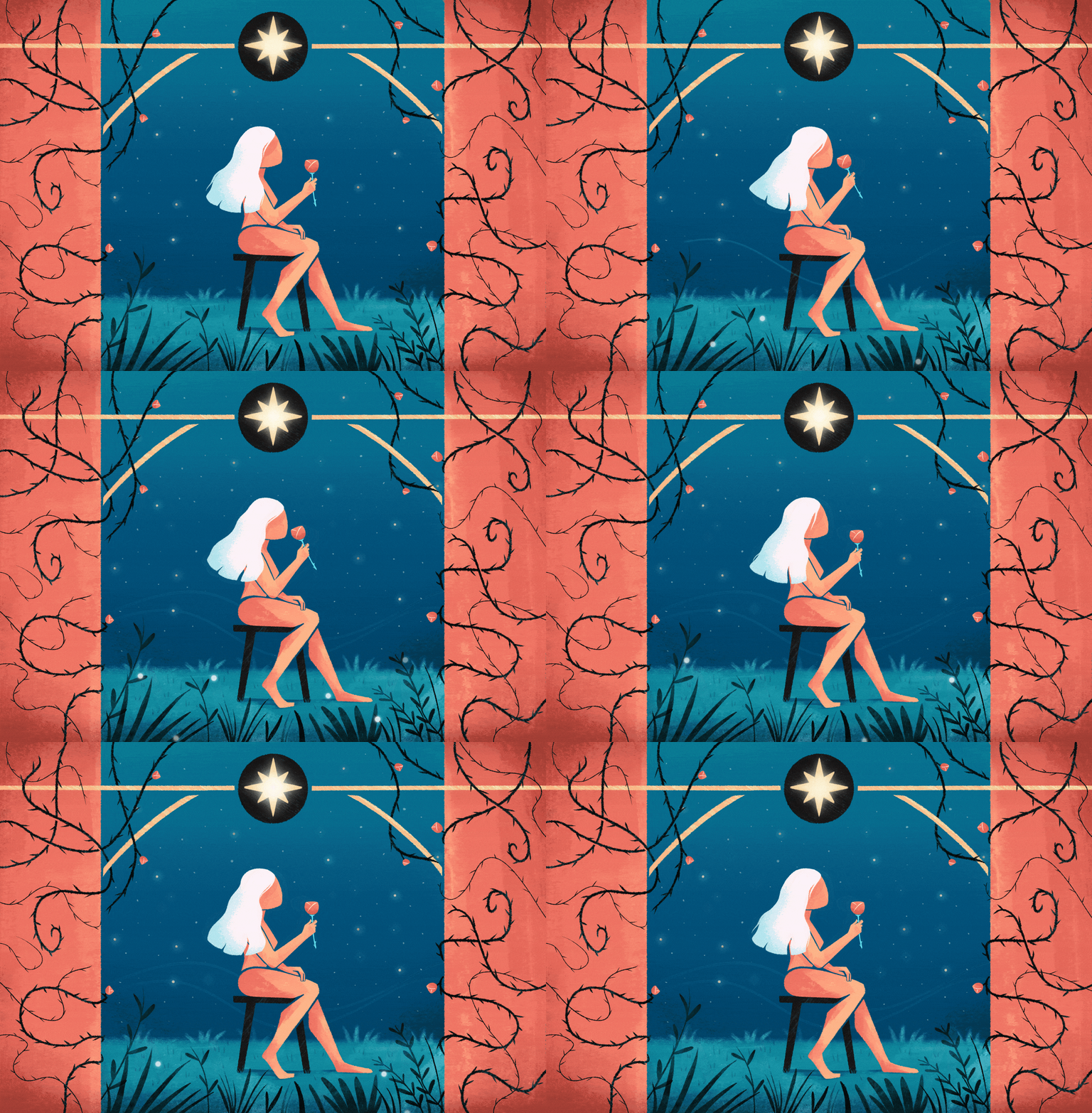
IN PARTNERSHIP WITH UNLIKELY COLLABORATORSIllustrations by Paula Rodriguez
by Karen Fischer
When I met my now-husband over a decade ago, we were both college students. I was living in downtown Chicago while he was in the cornfields west of the city, and each weekend, one of us made the trek by train or car to see the other.
Those weekends were largely defined by cooking elaborate meals and watching indie movies and TV shows. One of the go-to programs that we watched every week as it aired was Anthony Bourdain: Parts Unknown. We gravitated toward episodes featuring places we didn’t know much about at the time, like Myanmar, Russia, Iran, Manila, and Montana. The show brought these far-flung places to life, and we never forgot it.
A few years later, we took a year off from work to travel across the country camping and visiting national parks. As we rolled into one small town after the next, we made a habit of pawing through local thrift stores to find books to read by campfire at night. That’s how I read Kitchen Confidential, Bourdain’s breakout memoir of life in the culinary underbelly of New York City.
Because Bourdain’s written and visual media had such a great impact on us, my husband and I remember exactly where we were when we heard the news of his death in 2018. We were in an Airbnb in Ellijay, North Carolina, deep in the Smokies, in a room adorned with dusty Atlanta Braves memorabilia. We were both heartbroken over the loss of a stranger, and I still feel lucky to have a stockpile of media to revisit. Even after Bourdain’s death, his contributions spark the same curiosity, joy, and restlessness that my husband and I felt as young adults.
A few months ago, Spotify released Kitchen Confidential as an audiobook. Before long, I found myself listening to the author-read memoir to help me fall asleep on fretful nights. Hearing both Bourdain’s literal voice and literary voice became a regular, everyday glimmer of joy for me – one I hadn’t realized was missing in my media diet.
Anthony Bourdain lived a life that looked perfect to his fans from the outside, but no matter where he traveled, it didn’t stop him from suffering from anxiety, depression, or intense loneliness, even when surrounded by people. When I rediscovered Kitchen Confidential on Spotify, I was living abroad at a famous, idyllic beach. It was lonelier than I thought it would be.
This glimmer from a public figure isn’t a fluke. The notion of glimmers was articulated years ago by mental health professionals seeking ways to connect traumatized patients to small, fleeting moments of joy, with the hope that enough small glimmers could turn the present around.

Paula Rodriguez
History of glimmers
Deb Dana, LCSW, coined the term “glimmers” around 2014. At the time, Dana was working in clinical settings with trauma survivors, creating maps of triggers and glimmers. While triggers are quick moments that cause panic or distress in a person’s mind or body, a glimmer is often considered the opposite: a small moment of everyday joy, like seeing a stranger’s smile, admiring the shape of clouds in the sky, or spending quality time with a pet.
Living a life that others envy can be isolating. Within days of finding Bourdain’s Kitchen Nightmares on Spotify, I was diagnosed with Dengue fever, which ultimately led to a chronic disease. I convinced myself that loneliness was causing my illness and that I was receiving karmic retribution for wanting too much out of life. I thought my health situation was all my fault, and my anxiety was mighty, like a train.
“Trauma survivors are dysregulated in some way,” Dana says. “[Finding a glimmer means] actively experiencing moments of regulation not just to survive, but thrive… [It’s about] tracking positive moments, moments of okayness.”
I’d fallen into the trap of thinking I deserved my suffering. But the more I focused on noticing these glimmers—my own moments of okayness—the more I could see life beyond the limitations of past narratives.
Dana instructed her patients nearly a decade ago to find a single glimmer over the course of a week, and come to their next therapy session ready to talk about it. This homework of creating awareness of positive moments had a cumulative effect.
“[The glimmers] began to accumulate and build regulation,” says Dana. “When you stay regulated longer, you can hold onto it when challenged.”
Dr. Christine Gibson, a family doctor and trauma therapist, was studying polyvagal theory and how the nervous system can regulate or deregulate human behavior when she came across Deb Dana’s work and began to study it herself formally. Now, as a working therapist, Gibson talks about glimmers with about half her patient load.
“For most of my patients, because they’ve been through trauma, their brain is more adept at noticing the negative,” Gibson says. “[Glimmers are a] good way to practice shifting toward learning how to focus on positive, hopeful, or beautiful things, too.”
Gibson notes that one of the most powerful concepts within glimmers is the notion that neuroplasticity, otherwise known as brain rewiring, can be used to help a person shift into a neutral state simply by noticing sensations that are positive or hopeful around them.
I connected with a specialist who recommended a treatment to address my complications from Dengue fever, and I had to confirm via one more blood test that it worked. I was so nervous for the final exam that I was trembling. When the results came in, I saw the treatment plan was successful. I was in recovery. It occurred to me while I was sick abroad that getting ill had nothing to do with the cosmos or the idea that I had somehow deserved it.
Balancing triggers and glimmers
Dana is quick to clarify that many people mistakenly believe glimmers can erase deep-rooted triggers. In reality, identifying moments of joy doesn't erase painful memories. The breakthrough, Dana explains, is that the nervous system has the capacity to hold both trauma and glimmers simultaneously, allowing us to experience both.
“It can change the world if every human has more capacity for regulation. We can come together differently,” she says. “The capacity for regulations helps us see each other as human with similarities to work through our differences.”
By enhancing our capacity for regulation, we create more room for empathy, understanding, and connection with others. Our perception broadens, and we begin to view ourselves and those around us through a lens of shared humanity rather than isolated experiences.
My illness was just the beginning of a very long, difficult year, perhaps one of the hardest of my life. It started with being sick and thinking I deserved it, but that sentiment followed me through other challenging interactions with loved ones who made me feel as if I was the problem and always am. But in reality, it’s challenging to recover from illness. It’s hard to stand up for yourself or others when people try to take advantage of you. It’s hard to handle letting go of what you thought something was and accepting what it is.

Paula Rodriguez
Finding your glimmer
Gibson says where to find glimmers depends on the person, but pets, natural spaces, and music are good places to start. To generate fresh glimmers, Gibson recommends making your own art or sounds, like gentle ASMR-type sensations, which can be calming yet simple to create–even with household items.
Dana is adamant that glimmers are natural and all around us. Identifying glimmers is intended to be an easy reach, even during a time when recognizing a single glimmer is only possible occasionally. What Dana warns against is gamifying the idea of finding glimmers by setting self-requirements.
“As soon as you say I have to identify five glimmers a day, it becomes a should and an expectation instead of an invitation,” she says. “The nervous system wants to be invited, not demanded.”
A few days ago, I had a moment when I flashed back to the winter and spring of 2024, to needle pricks and sleepless nights, to moments I would give many things to forget. Then something simple occurred to me: “I feel so awful for that girl. These things are hard.”
Compassion for those who have hurt me might take a little longer, but compassion for myself is growing bit by bit, day by day.
Noticing life’s small glimmers of joy can spark gratitude, strengthen motivation, and nurture a more hopeful outlook.
Explore all the goodness birds bring to our homes, and the companion piece, an audiovisual article about bird friends.
Somatic mindfulness from children: Emi finds at least five simple things to savor with us.
Novelty can be an antidote for existential crisis, and there are many ways to seek it out.
Glimmers could be hearing your favorite song on the radio, or learning to play a new instrument as an adult.
Noticing and leaning into details in your space can be grounding – the way sunlight silhouettes a houseplant, or how certain textures or colors bring you joy.
Karen Fischer is an independent writer and reporter with bylines in publications such as The Verge, Eater, Business Insider, Prism Reports, Outrider Foundation, Next Avenue, and CQ Researcher, as well as on her website, kfischerwrites.com. She is a member of the Society of Environmental Journalists and the National Association of Science Writers.
Paula Rodriguez is a Colombian illustrator and animator based in Houston, Texas. Her work focuses on vibrant, reflective depictions of nature, animals, and quiet moments. Much of her inspiration comes from everyday walks with her dog and time spent birdwatching.