
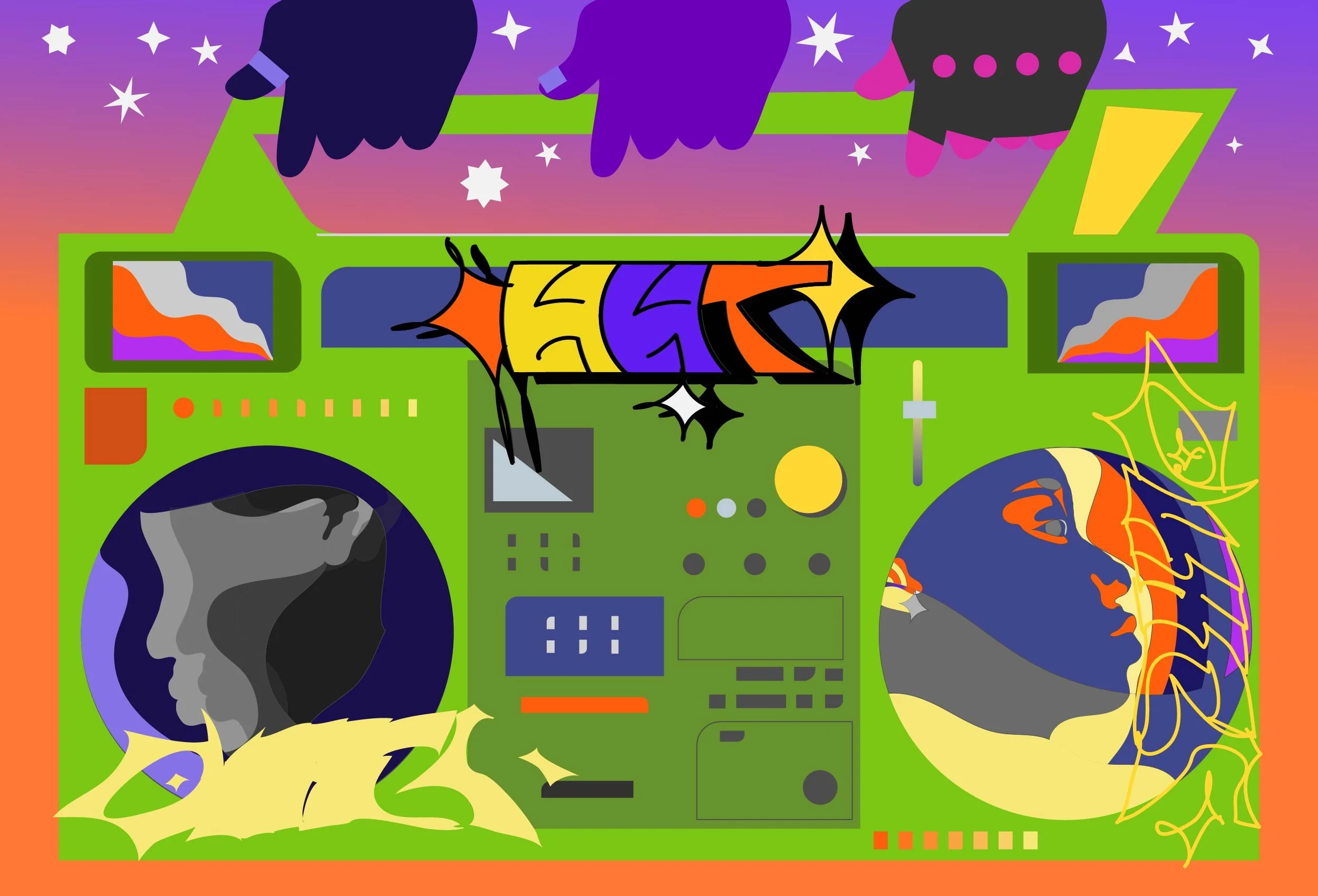
Illustrations by Neka King
by Sonia Chien
Hip-hop is one of the most popular musical genres in the world, and its reach goes beyond the charts. It accounts for close to a quarter of U.S. streaming alone, according to music-licensing platform Tracklib. For a growing number of therapists, social workers, and teachers, hip-hop is also a tool for healing. You probably already know music can change how you feel. This is about why that works, and some ways to lean into it.
What has made hip-hop so influential? Created by African American, Caribbean, and Latino youth in the Bronx, it has always had room for the whole range of human experience. Whether the topic is funny or serious, meaningful or materialistic, sad or uplifting, it’s likely been included in a hip-hop bar.
For communities facing systemic barriers to mental health care, hip-hop also became a vital form of expression. Khafre Jay, founder of Hip Hop For The Future, writes in a Mental Health America guest blog that this is part of why therapy rooted in hip-hop can feel more accessible and personally resonant than traditional models.
That need is especially urgent for groups who haven’t always had safe places to talk. Dr. Randolph Sconiers, a licensed clinical social worker, started the Mental-Hop program in 2017 to teach young people about mental health through hip-hop. He writes that hip-hop can reach people who face heavy stigma around mental health care, like Black and Brown men who may lack emotionally safe spaces to express their feelings. He points to rapper Meek Mill, who in 2021 tweeted “we gotta find a way to make therapy cool for the Black community.”
In all its forms, hip-hop has further meaningful implications in therapeutic practice, says J.C. Hall, an artist, clinical social worker, and founder of the Hip-Hop Therapy Studio at Mott Haven Community High School, a second-chance school in the South Bronx. About 30 students take part each year, writing, recording, and performing their own songs in a studio the school built from an old storage room. The program was featured in the award-winning short documentary Mott Haven.
“When a young person connects to their own creativity through an artistic medium like hip-hop, it provides an experience that produces awe and agency,” Hall says. “This can be profoundly enlivening in the face of powerlessness associated with exposure to trauma. Creativity and play are intrinsically linked.”
Hip-hop’s history of self-expression
Hip-hop’s capacity for the spectrum of human emotion goes hand in hand with its history. Some, including Sconiers, believe hip-hop’s roots reach even further back, to the music, movement, and healing ceremonies of Africa. But the story most often told starts in the South Bronx in the early 1970s, at a time when the neighborhood was being neglected.
Civil Rights leaders Malcolm X and Martin Luther King, Jr. were assassinated in the years before, and the country was still reeling. Decades earlier, the Cross Bronx Expressway, begun in 1948, displaced an estimated 40,000 to 60,000 people and sent property values plummeting. As the city pulled back services, residents were left to face drug use and gang violence with far fewer resources, a result of policy choices that disinvested from the neighborhood.
In memory of Cornell Benjamin (Black Benjie), a Bronxite gang member who was murdered while trying to broker peace, a truce formed between the area gangs paved the way for hip-hop’s humble beginnings at local parks and community centers.
In 1973, a young promoter and graffiti artist named Cindy Campbell asked her brother Clive to DJ her back-to-school party. Clive, who became known as DJ Kool Herc, was born in Jamaica and brought the island’s sound system traditions, including “toasting” via microphone over LPs, to the Bronx. At that party he pioneered “the break,” using two turntables and a mixer to loop the most danceable parts of records, and the dancing it sparked was intense and joyful. The Rock & Roll Hall of Fame, which inducted him in 2023, calls him one of hip-hop’s founding fathers.
As more block parties started to pop up, DJed by hip-hop’s earliest pioneers like Afrika Bambaataa and Grandmaster Flash, hip-hop culture started to take form. Heavily influenced by Afro-Caribbean, African American, and Latino cultures, what are now known as hip-hop’s five elements came to be — DJing (aural expression); MCing/rapping (oral); Breakdancing (physical); Graffiti (visual); and Knowledge of Self (mental).
Hip-hop became a way for youth in the Bronx and beyond to not only have fun and express themselves creatively, but also to understand themselves more deeply, talk about the pain in their lives and be supported by their community.
This culminated in hip-hop classics like “The Message,” in which Grandmaster Flash and the Furious Five rapped about the harsh realities of systemic inequality and life in neglected neighborhoods like the Bronx.
“When a young person connects to their own creativity through an artistic medium like hip-hop, it provides an experience that produces awe and agency.”
J.C. Hall, clinical social worker and founder of the Hip-Hop Therapy Studio
Illustration by Neka King
Hip-hop and therapy
In the mid-1990s, Dr. Edgar Tyson was a social worker at a residential treatment center in Miami, working with young people who had been abused, abandoned, or in trouble with the law. Getting them to talk in group was hard. According to Fordham News, in “Social Work Professor Taps into Hip-Hop for Healing,” Tyson noticed a 13-year-old who had just lost his grandmother singing along to Bone Thugs-n-Harmony’s “Tha Crossroads” in the cafeteria. When Tyson asked about the song later, the boy knew what it was about and explained how it connected to her.
Tyson called it his first “aha” moment, when he realized hip-hop could reach young people on a whole host of issues, not just grief. He later coined “Hip-Hop Therapy” (HHT), which involved the youth he worked with writing their own songs to share in a facilitated group. Today, hip-hop therapy means using hip-hop culture, like writing and recording songs or talking through lyrics, as part of working with a therapist toward specific goals.
J.C. Hall ran with his mentor Dr. Tyson’s model, integrating expressive arts therapy in his work at Mott Haven Community High School. Hall says he has seen the social and neurological effects on his students first-hand, time and time again.
“I have seen HHT be tremendously effective at helping people process significant traumas,” Hall says. “I have seen it create a space for collective healing, and bring clients back from the brink of serious self-harm and suicide.”
“I have also seen it breathe new life into individuals, providing a sense of joy, connection and purpose. In creating a safe space to play, young adults get the opportunity to let loose.”
Mott Haven isn’t the only program of its kind. NBC News reported that hip-hop therapy programs are popping up in schools and communities across the country, including the Cope Dealer program at Glenville High School in Cleveland. Kryst Jackson, then a teen, told NBC, “This is really just being able to express yourself in a fun way. What I learned about music is more than just lyrics on the beat. It’s what it could bring out of you.”
Hall’s own story helps explain why he does this work. As he told NBC, “Hip-hop, being like therapy, is what literally saved my life. It kept me going for a long time. I have no doubt this is gonna help a lot of people.”
Tyson passed away in 2018 and Hall built hiphoptherapy.com as a free resource to carry his mentor’s work forward. Hip-hop therapy is still a young field. Tyson himself said years ago that more outcome studies were needed for it to gain wider acceptance. It’s also not a replacement for other kinds of mental health care.
“I have seen HHT be tremendously effective at helping people process significant traumas. … I have also seen it breathe new life into individuals, providing a sense of joy, connection and purpose. In creating a safe space to play, young adults get the opportunity to let loose.”
J.C. Hall, clinical social worker and founder of the Hip-Hop Therapy Studio
Illustration by Neka King
How can hip-hop improve your wellbeing?
“When you engage in one of the many creative artforms of hip-hop, you are partaking in embodied practices,” Hall explains. “Hip-hop is an inherently somatic practice.”
The science is still catching up, but a few ideas help explain why this might work.
In The Body Keeps the Score, Dr. Bessel van der Kolk writes about how trauma is held in the body, and why healing has to involve the body, not just talking. He also points to language as a way to make sense of what happened, and to communal, rhythmic activities like dancing as a way to feel safe again.
That lines up with brain research on naming feelings. In a UCLA study, labeling emotions dialed down the response of the amygdala, the brain’s alarm center, and increased activity in a prefrontal region tied to thinking in words about emotions. That study used photos of faces, not lyrics, but it may help explain why writing bars about what you’re feeling can take some of the weight off.
Music also taps the brain’s reward system. In a small McGill University study, listeners released dopamine, a chemical tied to reward, both while hearing music that gave them chills and while anticipating it. It wasn’t about hip-hop specifically, but it matches what many of us already do: pick the song that fits our mood, or changes it.
Neuroscientist Dr. Bruce Perry has also written about the role of rhythm in nervous system regulation. Patterned, repetitive rhythm can create a sense of safety, which may connect to our earliest soothing experiences, like a mother’s heartbeat in the womb or being rocked as a baby.
When it comes to hip-hop, something as simple as a 4/4 beat and the addition of lyrics can create the foundation for healing and calm. “Not only are you creating a grounding environment to keep the nervous system regulated through rhythm, part of that rhythmic engagement is rooted in cognitions themselves, bridging that mind-body gap,” says Hall.
Dr. Sconiers calls hip-hop’s five elements its “pillars” and writes that each one lines up with wellness. He adds that all hip-hop asks of you is to respect it and stay true to it. That includes knowing where it comes from. Here are some ways to try them yourself.
Connect to yourself and others through hip-hop’s five pillars
MCing: Turn a “how I’m feeling” journal entry into some bars, or have a lyric-writing session with friends.
DJing: Create a mood-based playlist (relaxation, hype, motivation), and consider investing in an analog set-up. You could dig through a used record or CD bin or create a mixtape for a friend. CD players start at around $25, and used CDs can be as low as $1 each. Choosing every song on purpose engages your mind more than just hitting shuffle.
Breakdancing: It started at the same Bronx block parties as the music, where Herc’s looped breaks inspired intense, joyful dancing. It’s the physical element, and it’s what Hall means by hip-hop being somatic. You can learn the basics in a YouTube tutorial, or just put on a beat and move however feels good. It’s not about getting it “right.” If dancing isn’t your thing, meditation or breathwork can help you connect with your body too.
Graffiti: Many cities have legal art walls and community murals where anyone can paint. Not ready for a wall? Start in a notebook by designing your own tag, the stylized signature graffiti writers use.
Knowledge of Self: This element is all about educating yourself, thinking critically, and supporting your community. Learn more about yourself through a journaling (or junk journaling) practice. Consider lyrics you have heard recently. What do you like about them, or don’t? Where do your strengths lie, and how can you share them at school, with your friends or family?
You don’t have to be a good rapper, dancer, or DJ for any of this to work. Hip-hop started as a way for young people to make something out of what they were experiencing and share it together.
Sonia Chien is a freelance writer and aspiring fiction author. She studied politics in her hometown of Boston, MA, before receiving her MA in Journalism in Berlin, Germany, where she currently lives. Sonia enjoys exploring new genres and debating hot takes.
Neka King is a visual artist, teacher, textile artist, digital illustrator and muralist from New Orleans, based in Atlanta.
KEEP EXPLORING: